

Rebuild Your Foundation for a Stronger, Healthier Smile
Bone loss in the jaw happens quietly. A missing tooth, untreated gum disease, or an old extraction site can lead to the gradual deterioration of the bone that once anchored your teeth. By the time many patients come to see us, the bone loss is significant enough to affect their candidacy for dental implants or compromise the stability of remaining teeth. Bone grafting changes that.
At Rubino Periodontics and Implant Dentistry, Drs. Thomas, Ryan, and Tyler Rubino perform bone grafting procedures for patients throughout Bradenton, Sarasota, Lakewood Ranch, and Parrish. Their goal is simple: rebuild what was lost so you can move forward with the smile and function you deserve. If you are ready to find out whether bone grafting is the right step for you, call our Bradenton periodontist’s office at 941-209-5052, our Sarasota periodontist’s office at 941-201-3055, or our Parrish periodontist’s office at 813-331-5845.
We also welcome patients from Palmetto, Ellenton, and St. Petersburg.
Advanced Technology for Minimally Invasive Procedures at Rubino Periodontics
We use cutting-edge dental technology in order to provide the most efficient treatment, with minimal downtime.
Digital X-rays and 3-Dimensional CT Scans
Digital X-rays and 3-dimensional CT scans will be taken to inspect the bone levels around your teeth. When needed for even greater detail, additionally, a 3D CT scan will be taken of your entire jaw with our cone beam 3D CT scanner.
The scanner produces crisp 360° digital images of your entire jawbone, teeth, and surrounding structures. These images can be viewed from any angle and magnified to get a closer view. 3D images can show the exact density and volume of the bone that surrounds your teeth.
Using these digital images, your doctor is able to precisely plan any necessary bone grafting procedures ahead of time and place the grafts efficiently.
Piezosurgery Device for Minimally Invasive Bone Preparation
Sometimes, some diseased bone tissue needs to be removed, or the bone grafting site needs to be made into the optimum shape for a graft to be placed. Using a piezoelectric surgery device, Drs. Ryan, Tyler, and Thomas Rubino can gently sculpt the bone to accomplish this.
This instrument generates a micro-vibration that precisely sculpts bone but does not affect the surrounding soft tissues. This greatly minimizes trauma, is more precise and efficient, and makes the procedure minimally invasive.
What Is Bone Grafting?
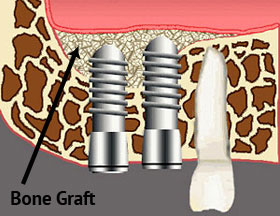 Bone grafting is a surgical procedure that rebuilds lost or deteriorated jawbone using graft material, which may come from your own body, a donor source, or a biocompatible synthetic material. Once placed, the graft material stimulates your body’s natural regenerative process, encouraging new bone cells to grow and integrate over time. The result is a denser, more stable jaw capable of supporting dental implants or maintaining the teeth you already have.
Types of Bone Grafts
The type of graft recommended depends on the location and severity of your bone loss, as well as the treatment goal. Your doctor uses several graft types depending on each patient’s clinical picture:
- Autografts: Bone taken from another site in your own body, often the jaw or chin.
- Allografts: Donor bone from a human tissue bank, processed and sterilized.
- Xenografts: Bone derived from animal sources, typically bovine.
- Alloplasts: Synthetic or biocompatible materials that mimic the properties of natural bone.
When Is Bone Grafting Necessary?
Drs. Thomas, Ryan, and Tyler Rubino recommend bone grafting for several clinical situations:
- Before dental implant placement: Implants require a minimum amount of bone height and density to fuse properly with the jaw.
- After tooth extraction: Following an extraction, the empty socket begins losing bone volume almost immediately. A socket preservation graft placed at the time of extraction protects the ridge and maintains the site for future implant placement.
- To support compromised teeth: Bone loss from advanced gum disease can leave teeth unstable.
- To restore jaw structure: Significant bone loss can change the shape of your face and make dentures difficult to fit.
- To treat bone loss from infection: Abscesses, jaw infections, or failed dental work can cause localized bone destruction.
Causes of Bone Loss
Gum Disease
Bacterial plaque and calculus (tartar) emit toxins that eat away at the ligaments and bone tissue surrounding the teeth. As the disease progresses in severity, the bone loss worsens until there is little or no support left for the teeth. This causes teeth to eventually be lost.
Missing Teeth
The bone surrounding your teeth needs stimulation from biting and chewing pressure to maintain its volume and density. When a tooth is missing, that pressure is absent, and the bone gradually dissolves away.
Tooth Misalignment
A tooth can be misaligned so that it does not make contact with the teeth in the opposing arch when you bite down. This sometimes severely reduces chewing and biting pressure (which is needed to maintain the bone around the tooth) and can lead to bone loss.
Infections in Your Jaw
Tumors, bacterial or viral infections not caused by gum disease, can develop in the bone tissue surrounding your teeth and can result in bone loss.
Injury to the Tooth
Tooth injury can cause the tooth to be thrown out of its proper position or become infected. Either the misalignment or the infection can lead to bone loss around that tooth.
How Dentures Accelerate Bone Loss
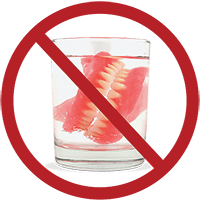 Dentures do not provide the stimulation needed to maintain the volume and density of your jawbone after your teeth are lost. In fact, the pressure exerted on your jaw by regular dentures actually accelerates the rate of bone loss and wears away the ridge of bone in your jaw. As the bony ridge dissolves away, your jaw loses height and thickness and literally shrinks. This can eventually cause the lower third of your face to get a “collapsed” look.
If you are wearing a traditional denture, the shrinking of your jawbone makes it necessary to continually refit the denture. The recurring lack of fit causes sore spots on your gums and can make chewing painful. It can get to a point where the bone loss is so severe that no denture will be able to fit snugly.
What to Expect During the Bone Grafting Procedure
Bone grafting at Rubino Periodontics is performed under local anesthesia, and sedation options are available for patients who prefer a more relaxed experience. The procedure typically follows these steps:
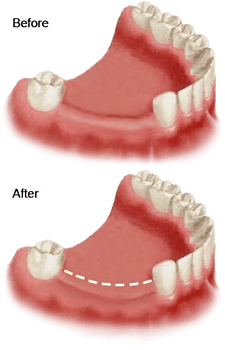 The treatment area is numbed, and the gum tissue is gently lifted to expose the bone defect
- Any infected or damaged tissue is cleaned from the site
- The graft material is placed into the defect and shaped to restore proper contour
- A membrane may be placed over the graft to protect it and guide bone regeneration
- The gum tissue is repositioned and sutured closed
- Healing begins as your body integrates the graft over the following weeks and months
Most patients return to normal activity within a few days. Full bone maturation takes several months, at which point implant placement or the next phase of treatment can proceed.
Here’s a section you can drop in before the FAQ or just before the closing CTA. It bridges naturally from the bone grafting content and gives each procedure enough context to earn the link without over-explaining.
Specialized Bone Grafting Procedures
Some patients require more targeted bone grafting techniques depending on where the bone loss has occurred and what treatment is planned next. Two of the most common specialized procedures, Drs. Thomas, Ryan, and Tyler Rubino perform sinus lifts and ridge augmentation.
Sinus Lift
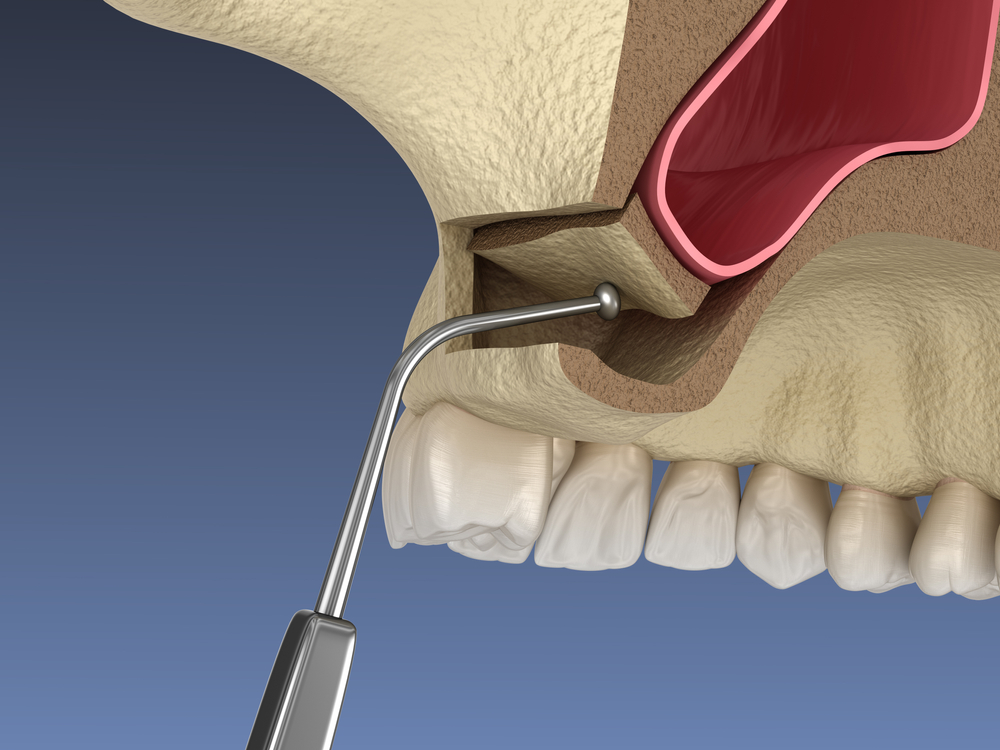 When bone loss has occurred in the upper back jaw, the sinus cavity can drop closer to the gumline, leaving insufficient bone depth for implant placement. A sinus lift, also called a sinus augmentation, addresses this by gently lifting the sinus membrane and placing graft material in the space below. Over several months, this material develops into stable bone capable of supporting one or more dental implants. Learn more about sinus lift procedures.
Ridge Augmentation
After a tooth is lost, the ridge of bone that once surrounded its root can collapse inward, leaving an uneven or narrow foundation. Ridge augmentation rebuilds this natural contour by placing graft material along the deficient area, restoring both the height and width of the jaw. This procedure is often recommended before implant placement and can also improve the appearance of the gumline beneath a bridge. Learn more about ridge augmentation.