
Missing Several Teeth in a Row?
If you’re missing multiple teeth in a row and want a permanent, natural-looking solution, an implant-supported bridge may be the right fit. Unlike a traditional bridge, which relies on grinding down healthy adjacent teeth, an implant-supported bridge anchors directly to the jawbone, restoring both function and appearance without sacrificing healthy tooth structure.
Call 941-201-3055 for Sarasota/Lakewood Ranch, 941-209-5052 for Bradenton, or 813-331-5845 for Parrish, or request an appointment online. We welcome families from Palmetto, St. Petersburg, and Venice.
Why a Periodontal Specialist Matters for Multi-Implant Bridges
 An implant-supported bridge only works long-term if every implant in the row integrates correctly, which is exactly the kind of case periodontists are trained for beyond general dental school. Drs. Thomas, Ryan, and Tyler Rubino completed additional years of specialty residency focused specifically on the bone and gum tissue that determine whether multi-implant restorations succeed. Because patients missing several teeth in a row are often older adults, medical history matters more here too. This is where our two in-house Registered Nurses come in, coordinating with your physician on any anticoagulant or antiplatelet medications before surgery.
Dr. Ryan Rubino’s own graduate research examined exactly this issue, studying postoperative bleeding risk in patients on blood-thinning medications, research that’s since been accepted for publication in a peer-reviewed journal. That combination, specialty training in multi-implant planning plus a genuine research background in surgical safety, is why patients trust our team with cases involving more than one implant at a time.
What Are Implant-Supported Bridges?
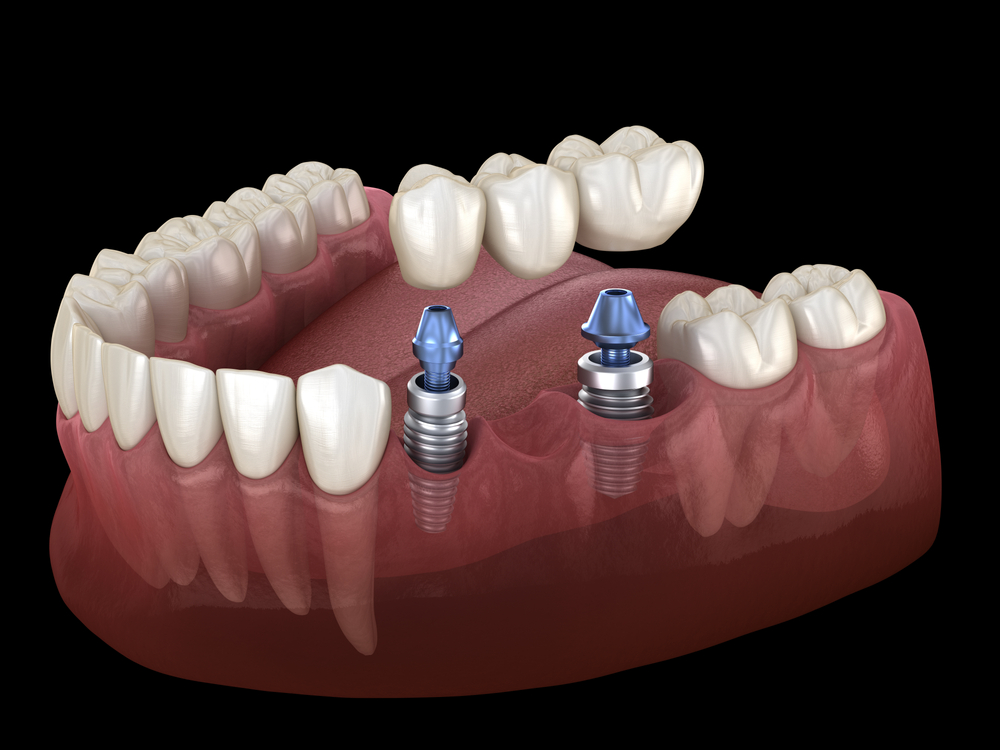
An implant-supported bridge replaces one or more missing teeth using dental implants for support rather than the neighboring natural teeth. It typically consists of titanium implant posts serving as artificial roots, abutments connecting the posts to the restoration, porcelain crowns matched to your natural teeth, and pontic teeth, the prosthetic teeth that span the gap and are anchored to the crowns on either side.
 Traditional Bridges vs. Implant-Supported Bridges
A traditional bridge requires the teeth on either side of the gap to be ground down to accept crowns that anchor the bridge in place, permanently altering healthy tooth structure in the process. An implant-supported bridge needs no such alteration, since it’s anchored in the jawbone itself. This distinction matters most when the teeth bordering the gap are otherwise perfectly healthy; grinding down healthy enamel to support a traditional bridge is generally considered more destructive than the more involved implant placement process.
Types of Implant-Supported Bridges
Several configurations are available depending on how many teeth you’re replacing and your specific anatomy:
- Fixed Implant-Supported Bridge: Permanently attached and not removable by the patient, functioning like natural teeth.
- Removable Implant-Supported Bridge: Connected to implants with connectors that allow the patient to remove it for cleaning.
- Full Arch Implant-Supported Bridge: Replaces an entire upper or lower arch, supported by multiple implants, for patients who’ve lost most or all teeth in that arch.
- Partial Arch Implant-Supported Bridge: Fills a gap of several missing teeth in a row, anchored to at least two implants.
- Cantilever Bridge: Anchored to an implant on only one side of the gap rather than both. This option is used less often, since it places more stress on a single implant, but can be appropriate in specific anatomical situations.
Cement-Retained vs. Screw-Retained Bridges
Beyond the bridge’s span and configuration, there’s also a choice in how the restoration attaches to the implant abutments. Cement-retained bridges are bonded in place with dental cement, offering a slightly more seamless appearance since there’s no visible access hole for a screw. Screw-retained bridges are secured with a small screw that can be removed by your dentist for adjustment or repair without damaging the restoration, which makes future maintenance simpler. We’ll discuss which approach fits your case, since the right choice depends on the location of the bridge, the number of implants involved, and how much future adjustability matters to you.
Benefits of Implant-Supported Bridges
- No adjacent tooth alteration: Neighboring healthy teeth are left completely intact.
- Jawbone preservation: Implants stimulate the bone the way a natural root would, unlike a traditional bridge.
- Long-lasting: With proper care, implant-supported bridges can last a lifetime, and if the visible bridge ever needs replacement, the implants underneath often don’t.
- Natural appearance and function: Designed to closely match your natural teeth in both look and bite function.
Are You a Candidate for an Implant-Supported Bridge?
Candidates need sufficient jawbone density at the implant sites and good overall oral health, without active periodontal disease or uncontrolled conditions like diabetes that could complicate healing. Non-smokers tend to have better outcomes, since smoking meaningfully increases the risk of implant failure. Our dental implant candidacy page covers the full range of factors we evaluate at your consultation.
How Many Teeth Can an Implant Bridge Replace?
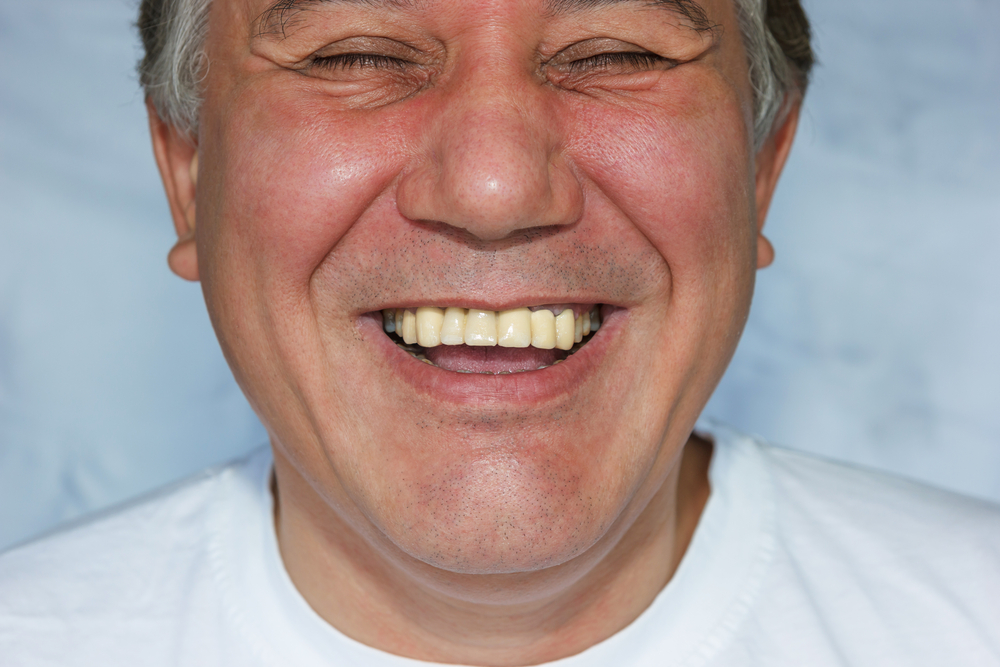 An implant-supported bridge can generally replace two to six teeth in a row, depending on implant placement and bone support. For more extensive tooth loss, spanning multiple sections of an arch or an entire arch, we may recommend multiple bridges, or an alternative like implant-supported dentures or All-on-4, depending on the specific pattern of missing teeth.
Implant-Supported Bridge Costs
Implant-supported bridges typically range from $5,000 to $15,000, depending on the number of implants needed, the materials used, and whether any supplemental procedures like bone grafting are required first. Our dental implant cost page breaks down the full range of pricing factors across all of our implant treatments.