

Tired of Dentures That Slip, Click, or Rub?
If you’re exploring options to replace missing teeth, or you’re frustrated with traditional dentures that never quite fit right, implant-supported dentures may be the answer. This treatment anchors a denture to dental implants, giving you the stability and confidence that removable dentures alone can’t provide.
Call 941-201-3055 for Sarasota/Lakewood Ranch, 941-209-5052 for Bradenton, or 813-331-5845 for Parrish, or schedule online. We welcome patients from Clearwater, St. Petersburg, and North Port.
Specialists in Helping Long-Term Denture Wearers Transition
 Patients switching from traditional dentures to implant support often arrive with years of frustration and, in some cases, significant bone loss from time spent in a denture that never stimulated the jawbone. Our team’s periodontal specialty training is built around evaluating exactly that kind of bone and soft tissue change.
Our newest periodontist, Dr. Priscilla Sosa, conducted clinical research during her residency on soft tissue procedures that support long-term implant health, directly relevant to the tissue considerations around a denture’s attachment points. Dr. Sosa is also fluent in English and Spanish, which matters for the many longtime denture wearers in our community who want to walk through this transition in the language they’re most comfortable in.
Why Traditional Dentures Fall Short
Dentures have long been the default solution for a missing arch of teeth, but they come with real limitations. Traditional dentures restore only about 10 to 20 percent of natural chewing power, which makes foods like steak or fresh fruit difficult or impossible to eat comfortably. They also rest on the gums rather than the jawbone, which means they don’t stop the bone loss that continues after tooth loss, and that ongoing bone loss is often exactly why dentures become looser over time and need frequent relining or replacement. Many long-term denture wearers also notice the lower third of their face gradually appears more sunken as a result.
What Are Implant-Supported Dentures?
Implant-supported dentures, sometimes called overdentures, are dental prosthetics anchored to the jawbone using dental implants rather than resting on the gums alone. The implants are surgically placed and allowed to fuse with the bone through osseointegration, after which an abutment connects to each implant, allowing the denture to snap securely into place.
Bar-Retained vs. Ball-Retained Dentures
There are two main attachment systems, and which one fits you depends on your jawbone anatomy and the number of implants placed:
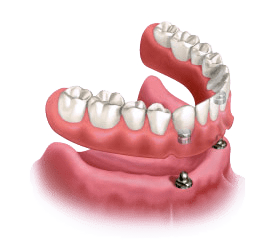 Bar-retained dentures use a thin metal bar fixed across the abutments of typically four or more implants. The denture clips onto this bar, which distributes chewing force evenly across all the implants and tends to offer the most stable fit, particularly for a full lower arch.
- Ball-retained dentures use individual ball-shaped attachments on each abutment, with matching sockets in the denture that snap onto each ball independently. This system typically requires fewer implants, often just two for a lower denture, and allows slightly more individual movement at each attachment point, which some patients find more comfortable.
Your consultation will include a discussion of which system fits your bone structure, the number of implants recommended for your case, and your personal preference between the two.
Partial vs. Full Implant-Supported Dentures
Implant-supported dentures aren’t just for patients missing an entire arch. A partial implant-supported denture can replace multiple missing teeth while still relying on remaining natural teeth for some support, which is a middle option between a single implant and a full-arch solution. We’ll evaluate which approach fits your specific pattern of tooth loss during your exam.
Benefits of Implant-Supported Dentures
- Enhanced Stability: Anchored to the jawbone, these dentures stay firmly in place without adhesives.
- Jawbone Preservation: The implants stimulate the jawbone, slowing the bone loss that accelerates with traditional dentures.
- Improved Chewing Function: Most patients regain the ability to eat foods they’d avoided for years.
- Removable for Cleaning: Unlike All-on-4, these dentures can be removed nightly, making cleaning more straightforward for many patients.
- More Accessible Than Full-Arch Fixed Options: Because fewer implants are typically needed than a fixed alternative, this option is often a more attainable stepping stone for patients with significant bone loss or budget constraints.
The Implant-Supported Denture Process
The implant placement process for overdentures is similar to most dental implant procedures:
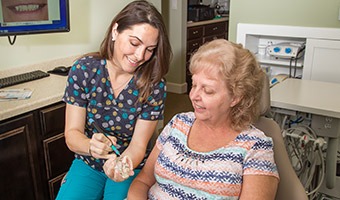 Initial Consultation: We evaluate your jawbone density and dental history to determine candidacy and which attachment system fits your case.
- Implant Placement: Titanium implants are surgically placed, typically under local anesthesia or sedation.
- Healing Phase: A healing period of three to six months allows the implants to fuse with your jawbone.
- Abutment Attachment: Once healed, abutments are attached to the implants to hold the denture securely.
- Custom Denture Fitting: Your custom denture is fabricated and fitted to snap onto the abutments, completing your new smile.
Are You a Candidate for Implant-Supported Dentures?
Candidates need sufficient jawbone density to support the implants, and good overall health without conditions that would complicate healing. If you’ve experienced significant bone loss, a bone grafting procedure may be needed first. Our dental implant candidacy page covers the full range of factors we evaluate, including for patients currently wearing traditional dentures who are considering the switch.
Maintaining Implant-Supported Dentures
Because these dentures are removable, nightly cleaning is part of the routine, along with daily care of the implants and attachment points themselves. Our dental implant maintenance page covers denture-specific cleaning around bar and ball attachments in detail. Plan on periodic adjustment of the denture’s fit over time, since even implant-supported dentures can require relining as your gum tissue changes, though far less frequently than traditional dentures.