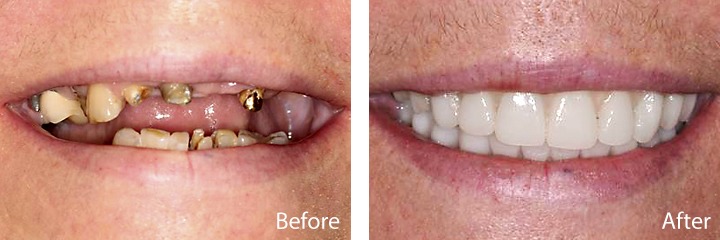
 Restoring the Shape and Strength of Your Jaw After Tooth Loss
After a tooth is removed, the bone that once surrounded its root begins to shrink. This process is called ridge resorption, and it happens faster than most patients expect. Within months, the once-full contour of the jaw can become narrow and uneven, creating cosmetic concerns and making implant placement difficult or impossible without rebuilding the bone first. Ridge augmentation is the procedure that restores the lost volume.
At Rubino Periodontics and Implant Dentistry, Drs. Thomas, Ryan, and Tyler Rubino perform ridge augmentation for patients who need to rebuild jawbone contour before dental implant placement or to restore the natural profile of the jaw. Call our Bradenton office at 941-209-5052, our Sarasota/Lakewood Ranch office at 941-201-3055, or our Parrish office at 813-331-5845 to schedule a consultation. We also serve patients from North Port, St. Petersburg, and Tampa.
The Connection Between Ridge Augmentation and Dental Implants
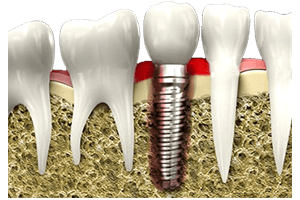 Ridge augmentation and dental implants are closely linked. Implants require a minimum bone width and height to be placed safely and to achieve the stability needed for long-term success. When the ridge has resorbed below that threshold, augmentation must come first.
Dr.. Rubino uses 3D cone beam imaging to measure ridge dimensions precisely and determine whether augmentation is needed, what volume of graft material is required, and where the implant will ultimately be positioned. This pre-surgical planning is one of the most important steps in achieving a predictable implant outcome, and it is something that requires the training and technology of a specialist periodontist.
What Is Ridge Augmentation?
Ridge augmentation is a bone grafting procedure that rebuilds the height and width of the alveolar ridge, the bony arch that houses your teeth. When teeth are lost, and the ridge collapses or shrinks, the jaw no longer has the proper dimensions to support dental implants or to create a natural-looking prosthetic restoration.
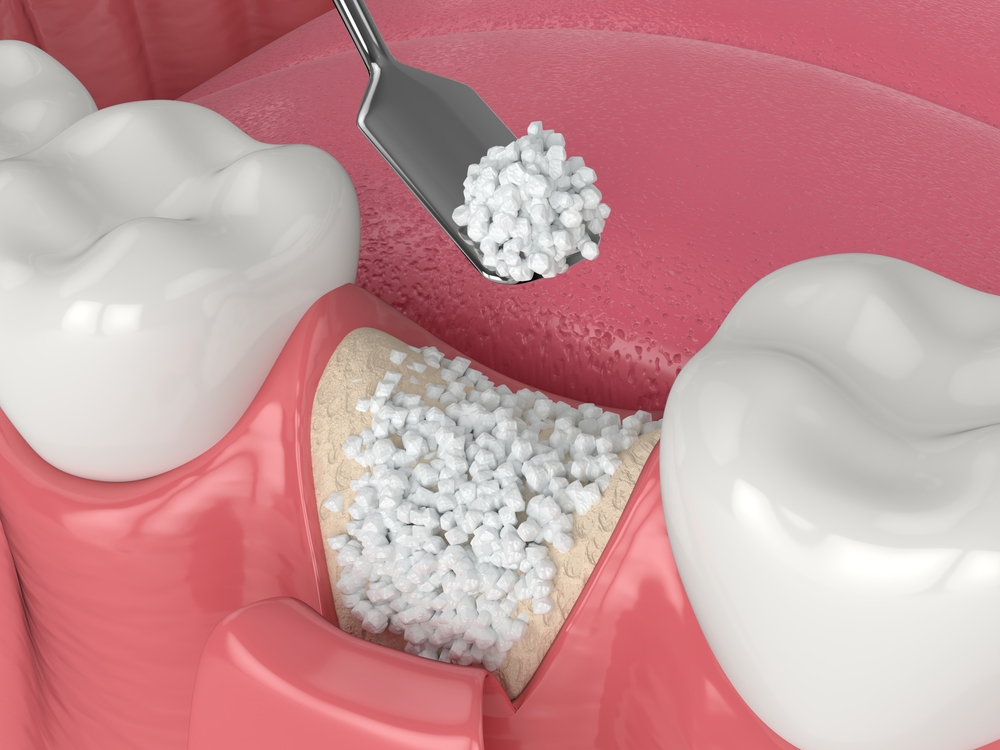 During ridge augmentation, bone graft material is placed along the deficient area of the ridge. The graft is held in position with a collagen membrane that guides bone regeneration and protects the site during healing. Over several months, the graft integrates with the existing bone, restoring the ridge to a shape and volume capable of supporting implants or fixed prosthetics.
Ridge augmentation can be performed immediately after tooth extraction, which is the preferred timing in most cases, or as a staged procedure months or years after tooth loss.
Why Ridge Resorption Happens
The jawbone depends on stimulation from the roots of teeth to maintain its density and shape. When a tooth is extracted, and nothing replaces that stimulation, the bone begins to resorb. The longer the site remains without a tooth or implant, the more pronounced the bone loss becomes.
Ridge resorption affects more than implant candidacy. It can change the appearance of the face, cause adjacent teeth to shift, make dentures fit poorly, and create an unnatural-looking gap in the jaw when viewed in profile. Addressing it early, ideally at the time of extraction, is always the most efficient approach.
Who Benefits From Ridge Augmentation?
Drs. Thomas, Ryan, and Tyler Rubino recommend ridge augmentation for patients in the following situations:
- Patients preparing for dental implants: Ridge augmentation is often necessary before implant placement when the existing bone is too narrow or too short to safely receive an implant fixture.
- Patients who had extractions without grafting: If a tooth was removed without a socket preservation graft, significant ridge collapse may have already occurred.
- Patients with a collapsed ridge under a bridge: Long-term use of a fixed dental bridge can mask the bone loss occurring beneath it.
- Patients with congenital bone deficiencies: Some patients are born with structural deficiencies in the jaw that require augmentation before restorative or implant treatment can proceed.
- Patients seeking improved aesthetics with dentures or prosthetics: A well-contoured ridge improves the fit and appearance of prosthetic restorations, even when implants are not planned.
What to Expect During Ridge Augmentation
Ridge augmentation at Rubino Periodontics is performed under local anesthesia, and sedation is available. The procedure is planned using cone beam 3D CT imaging, which provides an accurate picture of the existing ridge dimensions before treatment begins. The steps of the procedure include:
- The gum tissue is gently reflected to expose the deficient area of the ridge
- The bone surface is prepared to receive the graft material
- Bone graft material is placed along the deficient ridge and shaped to restore proper contour
- A collagen membrane is placed over the graft to protect it and support new bone growth
- The gum tissue is repositioned and sutured closed over the graft
- Healing proceeds over the following months as the graft integrates with the existing bone
Most patients return to normal daily activity within a few days of the procedure. Full healing and graft maturation typically take four to six months before implant placement or prosthetic work can move forward.